Date:
Audience:
Topics:
Resource Type:

Below you’ll find some helpful information on the basics to help design your Transitional Kindergarten (TK) program as it is expanded to all children who will have their fourth birthday by September 1 of the school year.
The California Department of Education (CDE) is regularly releasing guidance to inform the expansion of TK. You can explore their Transitional Kindergarten page to access the latest TK information and resources or contact their TK support team at [email protected].
The California Preschool/Transitional Kindergarten Learning Foundations (PTKLF) describe the knowledge and skills that most children, ages three to five and a half, develop in a high-quality, early learning program. They are intended for use in Transitional Kindergarten, the California State Preschool Program, and other state-funded, federally-funded, and private preschool programs in California including school-based, center-based, and home-based settings.
Additional TK resources from the CDE:
The expansion of TK occurred over a 4 year period, beginning in the 2022-23 school year and reaching full implementation in the 2025-2026 school year. A history of the implementation schedule is pictured and described below.
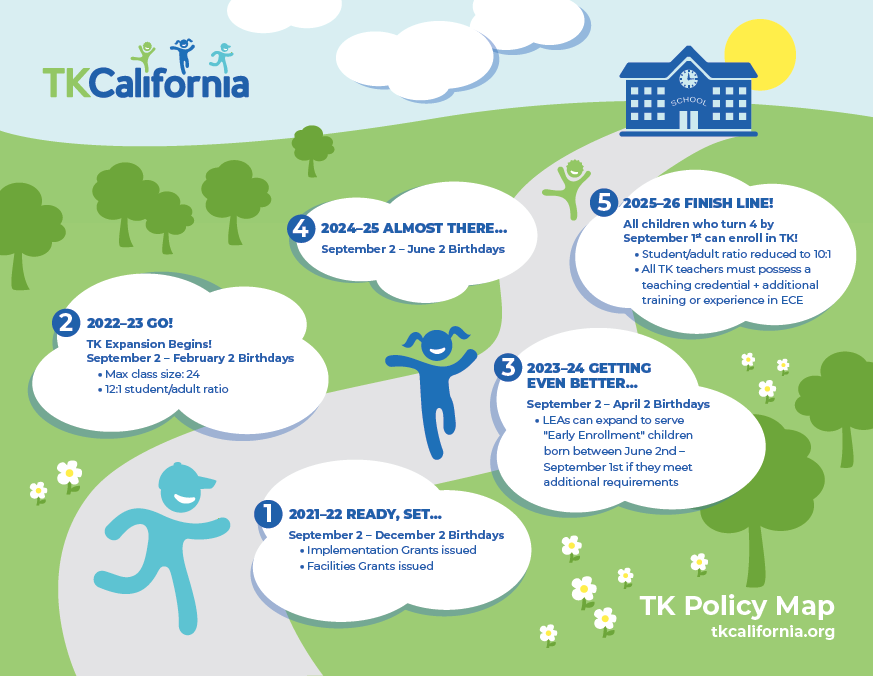

TK is described as the first year in a two-year Kindergarten program. However, one crucial way that TK differs from Kindergarten is in lower adult-child ratio requirements.
Beginning in the 2025-2026 school year, TK classrooms must have a 1:10 adult-to-student ratio throughout the instructional day.
For more information on calculating the adult-to-student ratio please refer to CDE FAQs.
Like Kindergarten, TK can be offered as either a full-day or a half-day program. While many districts prefer full-day schedules in order to support working families and provide more opportunities for learning for students, some districts may find it more feasible to implement the lower ratios required by TK using a half-day program.
For more information please refer to CDE FAQs.
With regards to required minutes of instruction, TK follows the same requirements that apply to Kindergarten: 36,000 minutes per year and a minimum of 180 minutes of instructional time.1
For districts that are interested in offering full-day Kindergarten and TK, the Education Code authorizes extended-day Kindergarten / full-day Kindergarten if the local school board adopts a policy establishing an Early Primary Program. Schools may offer extended or full-day Kindergarten if both of the following conditions are met:
In your school district, you have the flexibility to offer TK in a configuration that best meets the needs of your student population. The following are some of the class configuration models districts have adopted:
Many districts recognize that stand alone TK classrooms are the preferred program design, as a full classroom of 4-year-old children allows teachers to really build out a comprehensive TK program.
Some districts offer TK at select school sites, rather than every site due to low TK enrollment or facility constraints.
While the intent of the law is to provide two separate and unique learning experiences, TK/Kindergarten combo classes are permitted and can be useful in districts that are struggling with meeting the staffing and facilities needed to expand TK. Districts or schools are permitted to create TK/Kindergarten combo classes under the following guidelines:
This configuration may also help districts manage staffing and facilities needs while serving all TK-eligible children..CSPP/TK combination classes are required to follow Title 5 regulations, including an 8:1 student to adult ratio, bi-annual assessments using the Desired Results Developmental Profile (DRDP), and CSPP facilities standards unless exempted.
As with CSPP/TK combination classes, the more stringent classroom requirements apply. School districts combining TK and Head Start classrooms would need to meet Head Start requirements which include child-teacher ratios of 10:1, maximum class sizes of 20, use of the Classroom Assessment Scoring System (CLASS) assessment tool, and family engagement requirements.
Regardless of how TK classrooms are designed in your district, it is important for school staff to talk with parents about the TK approach in your district, and the ways in which that approach will meet the needs of their young learners.


It is currently optional for parents and guardians to decide whether they wish to enroll their children in Kindergarten and TK.3 Parents are not required to enroll their children in school until age six. It is, however, required for “each elementary or unified school district to offer Transitional Kindergarten and Kindergarten classes for all children eligible to attend,” see the CDE’s Universal Prekindergarten FAQs.
Districts generally begin recruitment for TK when they begin their outreach for Kindergarten enrollment. Districts may wish to partner with media and community partners to ensure that information on universal access to TK for all four year old children reaches parents in the neighborhood.
Enrollment packets for TK generally include information similar to that of Kindergarten, and are augmented with materials such as:
Local Educational Agencies (LEAs) should submit the Transitional Kindergarten (TK) grade level to the California Longitudinal Pupil Achievement Data System (CALPADS) for those students enrolling in a TK program. While TK is considered the first year of a two-year kindergarten program, for the purposes of data reporting and collection TK data should be submitted as a separate grade from Kindergarten.
Note: Information on this page was provided by School Services of California Inc.
| 1 | California State Education Code sections 46117 and 46201. |
| 2 | California State Education Code sections 8970-8974. |
| 3 | California Education Code Section 48200. |
| 4 | School Services of California Inc. Implementing Universal TK–The Nuts and Bolts. Webinar (November 9, 2021). |